Jack Demands Legal Proof
Young Captain Jack · The Son of a SoldierJack Demands Legal Proof is the central act of resistance in the paternity dispute between Jack and Dr. Mackey. When Dr. Mackey presents himself as Jack’s biological father, Jack refuses to let a bare assertion replace proof. His demand protects his standing as the legally adopted son of Mrs. Ruthven, preserves his loyalty to the woman who raised him, and shifts the question of identity from emotional pressure to evidence and law.
The Claim and the Crisis
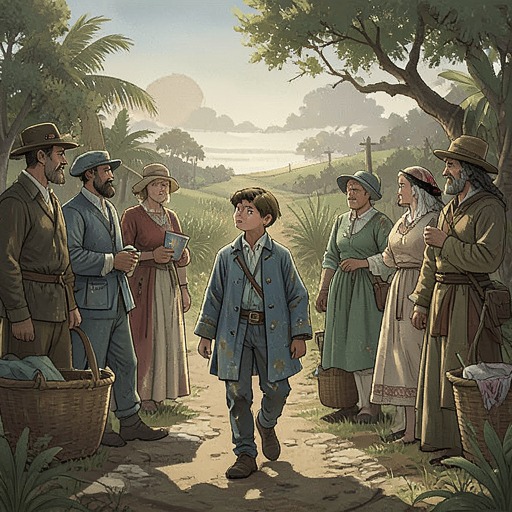
The confrontation follows a long uncertainty about Jack’s origins. Darcy Gilbert has reported that Jack is supposedly a nobody who does not belong to the Ruthven family, while Marion Ruthven has explained that Jack was adopted when he was about three or four years old and is now regarded as her brother. Mrs. Ruthven has preserved the few objects connected with Jack’s unknown mother: the woman’s unmarked clothing, a delicate lace handkerchief, and a ring whose worn inscription could not be read even after two jewelers examined it. The ring and the handkerchief establish the existence of a past that has not yet been securely interpreted, but they do not by themselves identify Jack’s father.
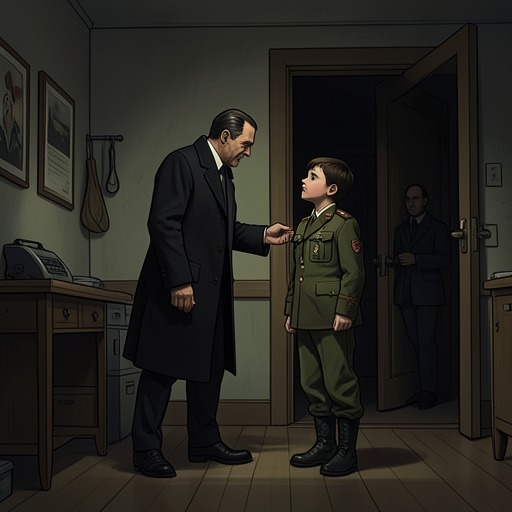
Dr. Mackey enters this uncertainty with an apparently complete answer. He first alludes to Jack’s resemblance to Walter and then declares, "Jack, I am your father!" When Jack recoils in astonishment, the doctor repeats that he is Jack’s father and asks him to accept the revelation as true. The claim is powerful because it supplies the biological identity Jack has been seeking, yet it is also immediately suspect: the doctor offers the assertion before offering a verifiable chain of evidence.
Jack’s Demand for Proof
Instead of treating Dr. Mackey’s confidence as proof, Jack asks him to establish his paternity. When the doctor harshly challenges this demand, Jack answers that he does wish the doctor to prove that he is his father and that, until such proof is supplied, Jack will remain with Mrs. Ruthven if she permits him to stay. The response converts a private revelation into a formal dispute over proof, custody, and competing claims to family membership.
Jack’s position becomes still firmer when he states that he does not acknowledge Dr. Mackey as his father. He refuses to leave the woman who has been a real mother to him and declares that he will remain with her until the doctor proves his claim in a court of law. This is not merely an expression of wounded feeling. Jack identifies a standard by which the claim can be tested and refuses to let the person making the claim control the terms of judgment.
Mrs. Ruthven immediately supports him. She explains that she has legally adopted Jack and that he has been as dear to her as if he were her own flesh and blood. Her statement gives the confrontation two distinct but mutually reinforcing forms of legitimacy: Jack has an emotional bond with her, and she possesses a legal relationship to him. The adoption does not answer the question of biological parentage, but it prevents Dr. Mackey from treating biology, even if eventually proved, as an automatic cancellation of the life Jack has already lived.
Competing Evidence and the Burden of Proof
When Mrs. Ruthven asks what actual proof Dr. Mackey possesses, he names private papers, a marriage certificate supposedly showing that he married Jack’s mother, and the future testimony of an old college acquaintance who knows the past. These are potential forms of evidence rather than established facts. The papers have not yet been produced, the certificate has not yet been examined, and the witness has not yet testified. Jack and Mrs. Ruthven therefore treat the doctor’s account as a claim awaiting corroboration, not as a settled identity.
Mrs. Ruthven says that she must make Dr. Mackey prove the claim for Jack’s sake and her own, because it would be difficult to give up the boy even after being assured that he was truly the doctor’s son. Her words define the burden of proof as belonging to the claimant. Dr. Mackey responds by saying that he will repay the money she has spent on Jack once his claim is proved; Mrs. Ruthven rejects the offer, making clear that her relationship with Jack is not a financial investment that can be balanced by reimbursement.
The dispute also reveals the different kinds of authority competing over Jack. Dr. Mackey invokes medicine, private documents, marriage, and possible courtroom action. Mrs. Ruthven invokes legal adoption and years of care. Jack invokes personal judgment and the right to withhold recognition until the evidence is tested. The scene thus treats identity as something established through a chain of testimony, documents, objects, and conduct rather than through the loudest declaration.
The Promise and the Threat
Unable to settle the matter immediately, Dr. Mackey demands a promise that Mrs. Ruthven will not spirit Jack away from the plantation and make him unavailable to a court. Mrs. Ruthven agrees because she does not wish to do anything contrary to law. Her promise preserves procedural fairness while refusing to concede the substance of the doctor’s claim. Jack remains where he has chosen to remain, but he is not hidden from lawful inquiry.
The agreement is therefore both a temporary settlement and a sign of continuing danger. Dr. Mackey warns that he may take immediate steps to remove Jack if the promise is not made, turning the language of legal process into a threat of coercive control. Later, when Jack openly calls Dr. Mackey a fraud, the doctor abandons even this restrained posture. He seizes Jack by both arms and orders Confederate soldiers to conduct the young man to camp and see that he does not escape. The threatened legal action has become physical detention, exposing the gap between Dr. Mackey’s claimed respect for law and his willingness to use force.
Resolution Through the Wider Evidence Chain
The later course of the story confirms the importance of Jack’s refusal to accept an unsupported identity. The paternity question is not resolved by Dr. Mackey’s papers or by his self-confidence. Colonel Stanton eventually identifies Jack as his son, and the claim is said to be proved beyond doubt. The narrative therefore replaces Dr. Mackey’s contested assertion with a broader chain of recognition involving the colonel’s past, the shipwrecked woman, the preserved belongings, and documents recovered from the black tin box taken from the Nautilus wreck.
The tin box is found in a small, filthy closet aboard the wreck, concealed beneath dirt and water damage. Jack discovers the heavy black-painted box, opens its padlock with a key from his own bunch, and later sees its contents returned to Colonel Stanton after the outlaws’ camp is searched. The colonel recognizes the papers as his precious documents and tells Jack that nothing now stands between them and their fortune. In this final evidentiary reversal, the objects preserved by the Ruthven household and the papers recovered from the wreck converge to establish the truth that Dr. Mackey tried to control through assertion and force.
Jack’s demand for legal proof consequently becomes more than a defensive speech. It is the moment when he refuses to be renamed by another man’s story. He can be called a Ruthven foster son, a nameless survivor of a shipwreck, Dr. Mackey’s supposed son, or Colonel Stanton’s proved son; each version carries different rights and loyalties. By insisting that the version governing his life must withstand examination, Jack protects the value of chosen family while leaving biological truth open to legitimate proof. The eventual recognition of Colonel Stanton as his father validates Jack’s skepticism and shows that courage in the story includes the courage to distrust a convenient answer until evidence makes it trustworthy.